Showing posts with label Aviation. Show all posts

Thursday, August 21, 2014

The "L" word: Demystifying Liability

In an op-ed in the New York Times, Damien Fowler recently offered some thoughts on "The Dangers of Private Planes."  I'm not going to go into the questionable accuracy of his statistics, or the fact that this may be a ploy to sell more copies of his book, but the article does bring up one serious and under-considered issue among GA pilots: liability.  This will be the first "Demystifying" article to try and explain some tricky legalese in plain English.  Please remember that Jacob is NOT (yet) a lawyer and this site DOES NOT offer legal advice.  If you need a legal opinion, go get a real lawyer. (*1)

What?

In legal terms, liability is "The quality or state of being legally obligated or accountable; legal responsibility to another or to society, enforceable by civil remedy or criminal punishment." (*2)
Huh?
Yeah, it can be confusing to lawyers, too.  In fact, that same legal dictionary entry cross-references 32(!) specific types.  We won't go through them all, but there are a couple of general things you need to know.  First, liability always means that a person (let's call him Andy) owes something to either an individual (Bob) or society as a whole (Country). (*3) Second, liability isn't a suggestion; Bob or Country have a right by law to extract whatever money, time, or other resource Andy owes them.  That right really means something: in most civil cases, Bob can sell it for cash to a willing buyer just like any other asset.  In every criminal case, it gives Country the right to throw Andy in jail (or enforce some other penalty).
So...what makes Andy liable?
There are a whole lot of ways to get there, but there are the three main ones you usually learn in your first year of law school.
  1. Contract. "Sell you my horse for $125," Andy says.  Bob shakes his hand and beams, "contract say we all." (*4) Bob is now liable to Andy for $125, and Andy likewise owes Bob a horse.  The necessary pieces of any contract are an offer, an acceptance, consideration (basically a price), and (sometimes) a writing that satisfies the statute of frauds. (*5)
  2. Tort.  If Andy steals Bob's plane (and Bob can prove it in court), Andy is liable to Bob for the cost of that plane. (*6)
  3. Criminal.  If Andy steals Bob's plane, and Country proves it in court, Andy owes Country jail time.
Wait...Andy's liable to Bob and Country for the same theft?
Yeah, though he owes them different things.  With a few exceptions, Andy's going to owe Bob money and Country time.  These are called civil and criminal penalties, respectively.  Those categories break down on occasion - Andy could owe Bob labor (specific performance) or Country money (fines, civil forfeiture, etc...) - but those are your general silos.

"I can't stall. I'm on a mission from me."
Who?

Do I need to be worried about this?
Yes, unless you're sinless.  Liability is the only reason most lawyers ever have any business, and as you've probably heard it said, everyone needs a good lawyer at least once in his or her life.  Liability doesn't always depend on intent; sometimes it doesn't even require any particular mental state.

Where?

So Bob can just take Andy's money?
Not exactly.  Liability is different from cash in hand in that you can't legally use force to make a debtor cough up that cash.  Only society has that authority, so Bob has to go through the civil court system (usually some kind of State court) to get a "judgment" against Andy.  Lawyers call this "civil procedure," and there are a jillion rules about how and how not to do it.  If Bob does end up getting a judgment in his favor, Andy's resources can be forced away from him by the court's authority under penalty of indefinite jail time.

It works roughly the same way on the criminal side: Country can't just throw Andy into prison because it thinks Andy did something wrong.  Instead, it has to prove to a court that it has a good reason for charging Andy, and then has to actually haul Andy into court to sort the whole thing out.  That's "criminal procedure."

One major difference between the two is that criminal (but not civil) defendants have a constitutional right to legal counsel, which the court can appoint to that defendant.  That means Andy has a right to a lawyer when Country comes after him, but not when Bob does.

When?

Is there something I can do before this all goes down to save my skin?
You bet.  There are two steps every pilot ought to take to cut down on the potentially catastrophic effects legal liability can have on your life.

First, reduce your risk.  Yes, I'm serious: the best way to avoid liability is to avoid liability, and we all know most accidents have pilot error as a primary factor.  There are a jillion ways to do this, but here are a few ideas you should take seriously:
  1. Make good decisions on the ground.  Know your weather, terrain, fuel/endurance, and other operational limits and stick to them.  Have a plan for the foreseeable.  Above all, know thy airplane.  If you listen at all to The Finer Points, you may have heard Jason Miller's philosophy on pre-flights; approach your inspection assuming there's some reason your bird can't fly, and make it your mission to find it.  If you fail, you may proceed.
  2. Make good decisions in the air.  I know I'm not the only pilot who chuckled the first time he hear Aeronautical Decision Making (ADM) was an actual portion of ground instruction, but it's serious stuff.  Specifically, consider your pneumonic devices and whether you can actually run through them in a pinch.  Get yourself into a simulator and see how you do with various system failures or emergent weather.  If your pneumonics fail you, work out the kinks or find something else - I'm a fan of visual or tactile flows.
  3. Use SOPs.  I promise The Finer Points hasn't paid me to do any advertising here, but Jason has an ebook out that talks a lot about this.  Standard operating procedures are a huge part of what helps airlines achieve a safety record more than two hundred times better than their general aviation counterparts, and constantly reevaluating your SOPs is as important as using them.
  4. Maintain your proficiency, not just your currentness.  Don't get in the air (or let anyone else get you in the air) unless you feel totally confident in your ability to get back down.  There are all kinds of "rusty pilot" resources available if you haven't done it for awhile, and CFIs are always happy to give an extra check-up.  If you're in an area with challenging terrain or regular visibility issues, consider some aerobatic or instrument training.  You'll enjoy the challenge and become an all-around better pilot.
Second, buy some sensible liability insurance.  No, your FBO's rental insurance is not enough.  I'll probably be doing another article to demystify insurance for pilots in the future, but you know the basics: you pay a company money each month/year/whatever in exchange for their promise to pay if someone makes a claim against you.  On its face, that's a very simple contract.  In reality, of course, it gets stickier.  You can't buy criminal insurance for reasons that should be pretty obvious, but you can buy all the civil liability insurance you want from anyone willing to bear the risk that you'll actually come a-calling.

How?

So what does all this have to do with that NYT article?
Fowler spends most of the article lambasting the safety record of General Aviation with questionable figures, but does offer an intriguing proposition: what if having liability insurance actually makes pilots safer?  His basic argument is that insurance companies are harder on pilots than the FAA, and higher standards make for safer pilots.

Regardless of the merits of that argument in the context of aviation, insurers in other sectors seem to believe they can reduce the claims made by or against the people they insure by modifying their behavior.  You see this fleshed out in safe driver discounts, Progressive's Snapshot program, Farmers' 15 Seconds of Smart ads, wellness programs, and a host of other means.

Manufacturers have also gotten into this game, especially with high-performance and homebuilt aircraft.  They've realized that it's cheaper to train pilots and give them a discount on their insurance than to insure them without that additional training.  The hyped-up concern around those aircraft may or may not be overdone, but if too much caution saves one life, the juice is worth the squeeze.

Why?

I only fly solo, in clear weather, over perfectly flat terrain, immediately after complete inspections, in unpopulated areas.  Why should I care?
First of all, you're a liar.  Nobody's perfect, and mistakes are as much a part of aviation as any other facet of human life.  We all know this, but there's something about also knowing we can lurch a heavier-than-air machine into the clouds and bring it back again that makes us pilots feel like saints, or maybe wizards.  You should care because you have made and will continue to make mistakes, and just because they have been cheap so far doesn't mean they'll stay that way.

Second, you should care because liability doesn't just affect you.  Depending on your financial planning, family situation, business organization, and a host of other factors, incurring a big financial burden on yourself could put the people around you into debt if you don't have an insurer lined up to step in.

Third, you should care, but you shouldn't let that worry drive you from aviation.  We all know or learn the risks of this passion through our observation, training, and pilotage, and while we can continue to improve there will always be something inherently risky about sitting thousands of feet above the surface of the earth.  Responsibility makes the world go 'round, but a life lived out of fear is no life at all.
--

*1 If you are an aviation lawyer and want to advertise on this site, please let me know.  I am a poor law student and will plug you shamelessly.
*2 Black's Law Dictionary 997 (9th ed. 2011).
*3 Technically, Bob could be a couple of people, or a partnership, or a corporation, or anybody else that's not "society."  You get the idea.  I'm pushing civil/criminal here, not individual/collective.
*4 Shamelessly stolen from papa Works' entire first year Contracts class.  I'm proud to be a disciple.
*5 I'm not going to explain the statutes of frauds, but they do matter.  Basically, they mean that certain kinds of contracts have to be in writing or there's no deal at all.
*6 Again, I'm not going into replacement cost, fair market value, or any of that.  Ask a lawyer.

Thursday, July 17, 2014

"Holding Short, Highway 35"?

If you listened all the way to about 4:10 in the video from my first post in the "Flying Cars" series, you may have heard Richard Gersh talk about one of the challenges facing his company's first production flying car: due to the regulatory separation between cars and planes, the Transition really has to live up to its name to go from byway to skyway.  The switch from car to plane doesn't take long, but it does require the pilot (not driver) to stop the vehicle, turn off the engine, and get out to do a normal pre-flight check.  As he says in the video, you need to find an actual runway to go airborne anywhere but Montana or Alaska.  Re-read that last sentence.  The vehicle doesn't fly that much faster than it drives, but claiming it could fly its way over a traffic jam in those two states was what really perked up my legal antennae.  I wondered where Gersh had gotten that idea, and Terrafugia was kind enough to give me a few minutes to ask him about it. *4

Gersh was quick to point out that this is not an intended SOP for this bird.  The switch has to happen on an airfield, and the wings should never be down on a roadway except in an emergency.  The main uses for driving the Transition will be getting to and from the airport, dodging inclement weather, and getting bizarre looks from other drivers.  The first two are no joke: hangar fees are high and climbing, and a quarter of all weather-related accidents are fatal.  Ok, enough with the disclaimer - let's get to the fun stuff.

On the state side of things, Gersh told me the bit about Alaska and Montana was something they'd been told anecdotally and wasn't too sure about the regs.  It's entirely plausible that the bush pilot capitol of the US and the only State with (at one time) no speed limit on some of its roads would be open to that kind of thing, but I'm slowly developing a need for written rules.  I dug into this problem a bit and found that many of the state and local governments that regulate most of the roadways in this country have actually had the foresight to deal with whether they may be used as runways.  Click here for a table with the statutes I've been able to compile so far, and feel free to shoot me an email if you know about regulations I've missed or mischaracterized in your state.  They fall into roughly four categories: free use (within local rules), use by permission, local ordinances authorized, or no use at all.  The "by permission" category leads the race right now.  States have gotten pretty creative in highway/runway enforcement on a couple of occasions, like the time a Minnesota State Trooper found a pilot and landscaper's aircraft intentionally parked on a roadside, advised the pilot that he would be cited for driving an overly wide vehicle, and allowed him to take off using the highway as a runway. (*3) Regardless, even states like Montana and Alaska don't seem to have put these rules to much use yet.  Props to those states that have seen this coming - all eyes will be on them to see how they handle tomorrow when it arrives.

Shown here over a perfectly tolerable commute.
On the federal side, when it comes to the airspace necessary for highway takeoffs and landings, the FAA has been a bit vague.  In a response letter to Jeff Buckholz of Buckholz Traffic, the agency seemed to indicate (*1) that it would treat the Transition just like any other "device that is used or intended to be used for flight in the air" in that takeoffs and landings would be governed by 14 C.F.R. 91.13 and 91.119.  As with any aircraft, pilots would be prohibited from operating the Transition "in a careless or reckless manner so as to endanger the life or property of another" under § 91.13.  § 91.119 prescribes minimum safe flight altitudes, and the combination of those sections would presumably ban my hypothetical traffic dodging except in emergency landing situations. (*2) The FARs also define an Airport as "an area of land or water that is used or intended to be used for the landing and takeoff of aircraft," so the FAA would presumably treat a state-owned roadway sanctioned for use as a runway (and lying under uncontrolled airspace) like any other uncontrolled grass strip.  I haven't yet looked into how recreational use statutes would fit into this framework, but I'll be doing an article on those in the next month or two.  Stay tuned.


In short, this is all uncharted water and it's tough to know how it will all shake out.  A few states seem to be open to the possibility of using their roadways as runways, and the FAA has not done anything to indicate they couldn't.  This will certainly be a fun field to watch.

All that said, Terrafugia's next project, the TF-X, blows these regulatory questions out of the water.  As Gersh said in the interview, this really is a Jetson-like machine, and their aspirations for its operation are nothing short of science fiction.

---

*1 Dep't of Transp. (D.O.T.) Fed. Aviation Admin., 2011 WL 3557314 (D.O.T. Aug. 8, 2011). You'll need a subscription to access it on Westlaw.
*2 Seee.g.Administrator v. Schwandt, 7 N.T.S.B. 1375 (1991) (finding that a pilot who landed his aircraft while other people were in close proximity to the landing site operated the aircraft in a careless or reckless manner); Administrator v. Hart, 6 N.T.S.B. 899 (1988) (finding that the minimum-altitude-flight regulations are violated when an aircraft descends in order to land at non-suitable landing site); Administrator v. Mollis, 2 N.T.S.B. 43 (1973) (finding that a pilot violated the pertinent regulations when he made a decision to land on a highway, which ultimately resulted in his aircraft colliding with a truck).
*3 State v. Sherbrooke, 633 N.W.2d 856, 859 (Minn. Ct. App. 2001).
*4 It was an absolute treat to talk to Richard - many thanks to Terrafugia for setting up the interview.  I'll be using other portions of this interview throughout the rest of this series.

Saturday, July 12, 2014

Demystifying the Pilot's Bill of Rights

First off, an apology: last week was a finals week for this law student, and the blog had to take a back seat.  We'll be back to the regular Thursday morning article starting this week.  Moving on...

Credit: AOPA
You may have seen some buzz recently about the second version of the Pilot's Bill of Rights being proposed by Sen. James Inhofe (R-Okla).  As a (nearly) third year law student and recently minted pilot, I was a little surprised I'd never heard of the first version.  If you're in that boat, fear not: this week, I'll take you through the 2012 version and touch on the changes the general aviation community seems to be endorsing in version 2.0.

What?

So you're saying we actually amended the Constitution to protect pilots' rights? 'Merica!
Eh...not quite.  The Pilot's Bill of Rights isn't exactly on par with the "real" Bill of Rights in that sense, but it is a real law that really does affect the rights of pilots.  You can read the first version in its entirety here.  The rule did four distinct things:
  1. Force both parties to use the Federal Rules of Evidence and Civil Procedure in any proceedings under 49 C.F.R. Part 821(C, D, or F) whenever practicable.  These subsections cover reviews and appeals of Administrator actions concerning pilot certificates.
  2. Except where it would threaten the integrity of the investigation, require the FAA to tell the person under investigation:
    • The nature of the investigation
    • That he or she doesn't need to respond to the notice
    • That a response to the notice can be used as evidence against him or her
    • That the administrator's report will be available to him or her
    • That air traffic data will be available to him or her
  3. Require the FAA to implement the "NOTAM Improvement Program" within 180 days.
  4. Require the Comptroller general to evaluate the FAA's medical certification process.
There are a lot more details, particularly about the air traffic data available to the person under investigation.  This was done in response to 

You can read the full bill from Sen. Inhofe's website.  Here's my highlight summary:

  1. Orders the FAA Administrator to expand the 3rd Class medical exemption to the operations and aircraft described in H.R. 3708 within 180 days.  The FAA would only be able to take enforcement action for medical violations if the FAA passes such rules in that time period.
  2. Reigns in some of the Customs and Border Parol practices that have come under very sharp criticism in the law few months.  Specifically, CBP will be prohibited from stopping and searching GA aircraft unless they have an articulable, reasonable suspicion of illegal activity or probable cause to believe that illegal activity is occurring.  Flying without a flight plan, flying into or out of fringe general aviation airports, or flying a flight path that is not a straight line for specified piloting or navigation reasons do not qualify for those grounds, but these rules are out the window in the event of an accident.
  3. Knocks out FAA control over appropriate usage of private built and owned hangars at airports receiving federal aid by directing the FAA Administrator to give local airport authorities that control.
  4. Amends the original Pilot's Bill of Rights:

    • Clarifies that appeals are not subject to exhaustion of administrative remedies.  This means pilots can appeal enforcement actions to U.S. District Court at any time.  Also clarifies that these appeals to Article III courts are to be de novo and the Administrator is to bear the burden of proof.
    • Expands the Bill's protections to all certificates issued by the FAA.
    • Requires the FAA to provide notification to an individual once they become subject to an FAA investigation in order to press charges.
    • Limits the scope of FAA document requests of certificate holders to the pertinent issues under investigation.
    • Brings back the FAA’s expungement policy which prevents the agency from retaining records of enforcement against an airmen certificate holder for 90 days if the agency does not take enforcement action or 5 years if it does.  It also prevents the FAA from publicizing pending enforcement actions against a covered certificate holder.

Why?

Is this really necessary? 
Shown here riding in to save the day
on his orange stallion.
Some of it is, but some of it is more like political positioning.

Sen. Inhofe is very anti-Washintonian in his political approach, and being the knight in shining armor to save the damsel in distress from the draconian agency suits him like a storybook.  The direct appeal to U.S. District court falls closer to this category because the FAA's enforcement actions are already subject to judicial review; the new bill gives pilots facing enforcement more options as to how they proceed, but it doesn't dramatically affect their likelihood of success.

On the other hand, there really are some significant issues that the revamp seeks to cure.  The two biggest-ticket items at the moment are 3rd Class Medical certification and the overly intrusive and unjustified stops by CBP (see the summary above).  These have both been all over the news in the U.S. aviation world - if you're unfamiliar with either, feel free to get googling.  I'll also be doing pieces on each in the near future.

Who?

Who's this Inhofe character anyway, and why does he care?
Sen. Inhofe is a CFI with over 10,000 of experience.  He has been through FAA enforcement for landing at a supposedly closed airstrip with a Cessna 340, despite the fact that there was no NOTAM. You can read about the experience here.  Whatever his faults, he is a diehard aviation advocate and this has become one of his pet issues.
So you're telling me that every alphabet soup pilot group out there supported this thing?  Sounds fishy to me.
You're not alone.  The bill did receive some considerable backlash from some general aviation journalists and advocates, but the majority seemed to favor the changes.  This revamp seems to have similar support.

How?

But Congress never gets anything done these days.  How the heck are they going to pass something like this?
Actually, Congress has a pretty decent track record of coming together when it comes to recent aviation legislation.  Check out the Small Plane Revitalization Act or FAA Modernization and Reform Act for starters.  Heck, the original Pilot's Bill of Rights was passed unanimously by the Senate, by a voice vote in the House, and immediately signed by the President in the middle of 2012, an extremely politicized and divisive election year.  This one (when it's proposed) and H.R. 3708 will be the bills to watch.

When?

So if this does happen, when will I see a change? 
Sen. Inhofe hasn't yet said when he'll drop the bill in the hopper, but we'll pick up a tracker button on the home page when he does.  If it does pass, we should see changes within 180 days from the FAA on the 3rd Class Medical and immediately on everything else.

Thursday, June 26, 2014

"Unfit for Flight" Part I

A few weeks ago, USA Today and its syndicates ran a story entitled "Unfit for Flight," the first of three articles criticizing general aviation's safety record over the last five decades.  It was pretty scathing - the long form is entitled "Safety last: Lies and coverups mask roots of small-plane carnage." This first story is divided into six subsections with objective, non-sensational headings like "Post-crash fires threaten helicopter passengers: IF IT'S CHEAPER TO LET YOU DIE THAN FIX IT, YOU'RE GOING TO DIE."

Predictably, general aviation advocates have lashed back in force, saying the article mischaracterizes the industry and ignores a vastly improved safety record over the same period.  They say the report unfairly "paints GA aircraft as death traps, pilots as amateur, and aircraft manufacturers as villains, and pits pilots against manufacturers" while selectively ignoring information running counter to the shock value of the story.

So...who do you believe?  Is general aviation dangerous?  Has its safety improved?  Is anybody here telling the truth?

Maybe.

I listened to a radio story a while back about the relationship between a prisoner in jail and his corrections officer.  The officer had ordered the prisoner to pick up dandelions as a disciplinary action.  It's worth a listen, but here's the excerpt "Unfit for Flight" brought to mind: *1

Lt. Cecil Dooley

OK. So you're still upset over the dandelion deal?

Antwaun Wells

Yes, I really am. That really actually frustrated me.

Lt. Cecil Dooley

If you wouldn't have bucked up against that officer that day--

Antwaun Wells

But see, that's what I'm saying. You never came and asked me exactly what happened.

Lt. Cecil Dooley

Don't need to.

Antwaun Wells

Exactly. You took your officer's word and you left it at that. It's always three sides to each story. My side, his side, and the truth.  You left two sides out and you went off of what your officer said. You never came to me as a man and asked me. You know what I'm saying?
The amalgamation of this article and its backlash are one side and another, and neither seems to be particularly concerned about objectively portraying the truth.  As a card-carrying member myself, the most interesting reading has been the comments from other AOPA members on our association's own PR.
"Seems this guy had an idea for ["Unfit for Flight"] and a direction he wanted to go with it ..... evidence to the contrary be damned. Imagine if every car on the road was required to pass an annual inspection, every driver to be proved medically fit, any modifications made to that factory built car required an STC and driver needing to prove their driving skills every 2 years minimum.
"The AOPA response reads like it was written by a lobbyist for aircraft manufacturers instead of a group supporting owners and pilots ... Does the NTSB’s reliance on manufacturer reps and exclusion of pilot reps makes sense? Since NTSB conclusions are not admissible in court, what is wrong with allowing a pilot representative to participate in the investigation? What are the manufacturers afraid of?"
"I find it hard to believe the timing of this piece is not somehow connected to the pressure the FAA is feeling regarding the third-class medical. I doubt a sudden ostensible expose trying to paint GA as extremely dangerous appearing now, despite the recent dramatic decline in incidents that it fails to even mention, is a coincidence."
I called this post "Part I" because I imagine I'll be coming back to debunk some of the mischaracterizations and misinformation from both sides.  For my part, I'll call them out on this: block-quoting legalese to add shock value to general journalism is inaccurate, unethical, and contrary to USA Today's mission "to serve as a forum for better understanding and unity to help make the USA truly one nation."  Shame on the author and editor.  On the other hand, the article does bring up some legal questions that have piqued my curiosity.  Stay tuned.

In the end, we all need to do our own reading and come to our own conclusions.  I'll keep trying to help you wade through the muck.

--

*1 The irony that I'm excerpting a long piece in my story about an article that selectively picked and chose information is not lost on me.  The whole thing really is worth a listen, and I'll even give you a teaser: the cop looks like the bad guy now, but in the end the prisoner almost sees the situation his way.

Thursday, June 5, 2014

What's In a (Tail) Number?

If you speak Spanish, or any number of other languages, you may know that the English "my name is X" doesn't always directly translate.  Those languages say "I call myself X," and while the difference is subtle it really affects the way you think about your moniker.  The English is passive; we call our first names "given" and our last names "family," meaning we have little to do with the naming.  The Spanish is active; I call myself something every day, and others share in that activity with me.

"Lincoln ground, Cherokee 8619E."

I'll never forget the first time I said that sentence.  I had a new label, but it was more than that.  It was a new way of calling myself - a new way to tell others who and what I was, but also to tell myself.  It was like the first time a coach called my by my last name when I started playing football or the first time I called myself by my job title, but it didn't just add to my name.  It replaced it.

Harrison Ford talks about this anonymity in the "Just Another Pilot" video I recently wrote about.  He talks about the release he feels knowing he's identified as the pilot of a Beaver rather than a Millennium Falcon, and it frees him to experience the world in a completely different way.  While not all of us need to escape our celebrity status to relax, I think most of us do take some solace in hiding behind the microphone.

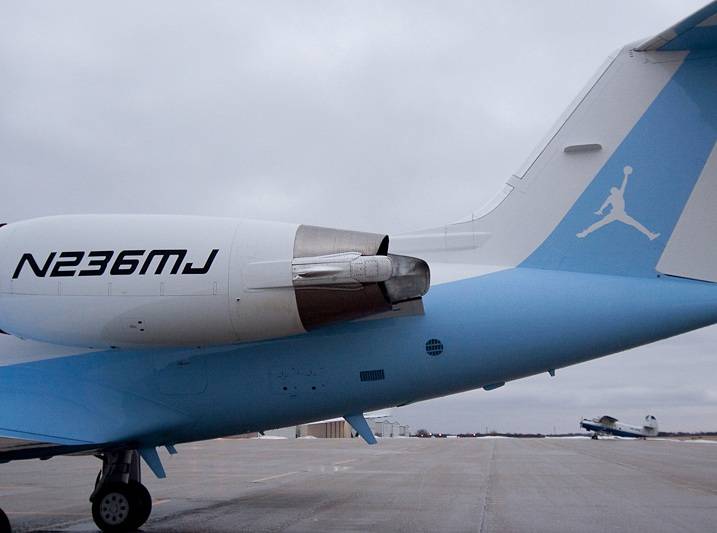
Michael Jordan: #23, 6 NBA Championship Rings.
Of course, you can always customize your N-number (within some pretty specific FAR limits) if you'd rather broadcast your identity to the world.  Actually, at $10, it's a better deal than the vanity plates in my home state.  Passengers out there, have you ever wondered why so you hear so many "November"s over the radio on cross-country trips?* ID numbers on every plane registered in the US must begin with "N" by law - every from Guernsey to South Africa has a similar international identifier.  There are plenty of vanities already registered (N1KE, N32MJ, and N236MJ, among others) so jump on it if you're too good for Harrison Ford.

Since 99% of us aren't too good for Harrison Ford, we'll continue to experience the thrill of learning new ways to call ourselves every time we hop behind a new yoke.  Language is strongly linked to memory, and self-recognition to autobiographical memory in particular.  To come full circle, these letters and numbers we use to steer clear of traffic in the sky become a deeply integrated part of how we perceive ourselves as pilots.  A passenger once told me that she had trouble picking out our call sign among all the ATC jargon in the sky, and I realized that what sounded to her like gibberish has begun to sound to me like poetry.

--

*A recent passenger, who shall remain anonymous, actually asked this on my last trip.


Thursday, May 29, 2014

Tradition

I was listening to an interview the other day with the man responsible for the lyrics in Fiddler On The Roof, which happens to be celebrating its 50 year anniversary.  He spoke about many interesting facets of the show, but I thought the most interesting few minutes were about the songs they didn't end up using, including the original opening number.
"It wasn't used because when Jerome Robbins became our director, we had many, many meetings before we went on to rehearsal. At each meeting he started with the same question: what is this show about? And he would say there's something that gives this show its power and we don't know what it is. And finally at one of those meetings one of us said hey, you know what this show is about? It's about changing of the way of life of a people in these Eastern European communities, these little towns, these shtetls, and Robbins got very excited about that. He said if that's the case, then what you have to write is a number about traditions, because we're going to see those traditions change. And that's so important in the show. Every scene or every other scene will be about whether a tradition changes or whether it remains the same. So instead of a song with the mother and the daughters getting ready for the Sabbath, he wanted us to write a song about tradition because he thought that's what the show is really about."

This weekend I had the chance to visit my fiancĂ©'s family cabin for Memorial Day weekend.  If you grew up somewhere other than the Northwoods (like I did), you may not understand the traditional significance of that holiday in that part of the world.  It's the unofficial start of summer, and it's easy to see just how widespread that celebration is when you're actually there.  Towns double in size, boat engines roar to life for the first time in months, and spirits are high.  These folks are creatures of habit in a strange but endearing way.

While I did grow up as a creature of the plains, I was extremely fortunate to have experienced aviation from an early age through the pilots God gave me for a father and grandfather.  I've heard it said that there are ultimately only old pilots and bold pilots, and becoming a third-generation old pilot is definitely a tradition I aim to honor.

My future grandmother in law sees us off
This weekend, our family traditions collided when I flew that rental Archer up to D25.  It's a marvelous little airport if you ever have the chance to visit.  I had the opportunity to take my future father in law and grandfather in law up for a little aerial tour of the area they've been frequenting for decades by car, and it was an experience I will absolutely never forget.

I think we as general aviators know Tevye's love for tradition as well as anyone.  Our planes are, on average, over 40 years old.  At our best, we rely on checklists and procedures to give our flights a firm foundation.  At our worst, we get stuck longing for the golden age of aviation to return without actually getting off our rears and doing what we can about it, and I think that's the side that concerns me.  If you haven't seen Fiddler, watched the above clip, or heard of the concept of foreshadowing, here's a little spoiler alert: in the end, Tevye's traditions can't save his village from the sweeping societal changes knocking at his door.  Its residents are eventually forced to adapt, but one can only imagine how much more difficult that integration was as a result of their longtime resistance.  On the one hand, they experienced a life very few others around the world were able to perceive.  On the other, that same world left them in the dust.

So what's it going to be?  Will we continue to lose 10,000 private pilots per year, dump lead into the atmosphere out of Metathesiophobia, or resist technological changes that will increase situational awareness for every pilot? Or will we honor our collective heritage by embracing the future with all its costs and benefits, and make of it what we can?

Let's choose the latter.  Let's honor our collective heritage of innovation and responsibility that has made aviation great. Let's fly.

Thursday, May 22, 2014

Freedom and Responsibility

If you've never seen this video, do yourself a favor and watch it.  The actual interview starts at :40.


A very experienced GA pilot first shared this with me long before I had my own wings, and it's stuck with me.  I love Harrison as an actor, but I think I appreciate his words in this little clip more than any of his many films.  His story of becoming a pilot is probably different from most, but nevertheless relatable.  He exhibits the drive that makes any good pilot good: a desire to constantly improve and broaden his abilities.  He's lucky enough to fly for fun, but many would see him as even luckier for being able to incorporate GA into his non-aviation career.  In any case, he humbly recognizes that luck for what it is.  He is almost shockingly humble about his success, which makes you want to empathize with rather than mock his failings - you can't help but laugh along when you visualize his first solo (3:44).  His appreciation for small towns and small-town people also reflects one of the beautiful aspects of GA.  Even having grown up in a state with more cows than people, hopping into a little local airport feels to me like stepping back to a simpler era built on history and mutual trust.

What I really love about this video is when Harrison talks about why he flies.  Ask any pilot to do the same and freedom will be high the list (if they're honest); nobody gets into this because it's cheaper or safer than other modes of transportation.  But it is the mixture of freedom and responsibility (5:08) that fuels the adrenalin from takeoff to touchdown.  We pay dearly for the opportunity to launch into the sky, but that makes us value every second.  We take our lives (and those of our passengers) into our hands every time we line up on the numbers, but the gravity of that situation heightens our senses.  I think overcoming both of these hurdles is what makes us not only glad but proud to fly, and keeps us coming back for more.

Saturday, May 17, 2014

Determination

What is it about the sky that makes us wonder?  Its blueness?  Its vastness?  Its usefulness or mystery or distance from home?  Whatever it is, we seem to keep our necks craned and our eyes wide.

I was walking around my grandparents' place the other morning, trying to identify the low-and-slow a few thousand feet above my head, when my eye caught something odd.

I'm no botanical expert, but I know one thing about that tree: it couldn't thrive in the space it was placed.  Maybe it had a biological issue within itself.  Maybe there was an environmental obstacle, or maybe some other plant grew in to block its place.  By whatever method, nature blocked the conventional route - but that tree wanted to go up, and it found a way.

I think this tree embodies the spirit of aviation both historically and today.  Humans found themselves shackled to the ground they walked on until they realized they could make vehicles that skidded or rolled.  Then they realized they could make their vehicles float and opened up a whole new world of discovery, but even once they discovered ways to penetrate the sky I believe they've never stopped looking up.  They probably never will.  At our roots we are firmly in the dust, and to dust we will return, but we will stretch upward and outward until that day comes.

Today, pilots find themselves simultaneously creating new ways to reach the heavens and dealing with new hurdles that try to keep them on the ground.  For some, it may be excessive regulation.  For others, personal health.  Maybe it's the financial burden, or the risk flying places on life itself.  But like that tree, we find a way.  We adapt, and grow, and find a way to be further into the air than we were yesterday.

Monday, May 12, 2014

Getting Off the Ground

Hello and welcome to TFL.  This isn't a law firm and I'm not a lawyer (yet).  This is just my way of funneling my passion for general aviation through my small but growing ability as a law student to hopefully come up with something useful for you.  Thanks for reading and welcome aboard!