Thursday, July 17, 2014

"Holding Short, Highway 35"?

If you listened all the way to about 4:10 in the video from my first post in the "Flying Cars" series, you may have heard Richard Gersh talk about one of the challenges facing his company's first production flying car: due to the regulatory separation between cars and planes, the Transition really has to live up to its name to go from byway to skyway.  The switch from car to plane doesn't take long, but it does require the pilot (not driver) to stop the vehicle, turn off the engine, and get out to do a normal pre-flight check.  As he says in the video, you need to find an actual runway to go airborne anywhere but Montana or Alaska.  Re-read that last sentence.  The vehicle doesn't fly that much faster than it drives, but claiming it could fly its way over a traffic jam in those two states was what really perked up my legal antennae.  I wondered where Gersh had gotten that idea, and Terrafugia was kind enough to give me a few minutes to ask him about it. *4

Gersh was quick to point out that this is not an intended SOP for this bird.  The switch has to happen on an airfield, and the wings should never be down on a roadway except in an emergency.  The main uses for driving the Transition will be getting to and from the airport, dodging inclement weather, and getting bizarre looks from other drivers.  The first two are no joke: hangar fees are high and climbing, and a quarter of all weather-related accidents are fatal.  Ok, enough with the disclaimer - let's get to the fun stuff.

On the state side of things, Gersh told me the bit about Alaska and Montana was something they'd been told anecdotally and wasn't too sure about the regs.  It's entirely plausible that the bush pilot capitol of the US and the only State with (at one time) no speed limit on some of its roads would be open to that kind of thing, but I'm slowly developing a need for written rules.  I dug into this problem a bit and found that many of the state and local governments that regulate most of the roadways in this country have actually had the foresight to deal with whether they may be used as runways.  Click here for a table with the statutes I've been able to compile so far, and feel free to shoot me an email if you know about regulations I've missed or mischaracterized in your state.  They fall into roughly four categories: free use (within local rules), use by permission, local ordinances authorized, or no use at all.  The "by permission" category leads the race right now.  States have gotten pretty creative in highway/runway enforcement on a couple of occasions, like the time a Minnesota State Trooper found a pilot and landscaper's aircraft intentionally parked on a roadside, advised the pilot that he would be cited for driving an overly wide vehicle, and allowed him to take off using the highway as a runway. (*3) Regardless, even states like Montana and Alaska don't seem to have put these rules to much use yet.  Props to those states that have seen this coming - all eyes will be on them to see how they handle tomorrow when it arrives.

Shown here over a perfectly tolerable commute.
On the federal side, when it comes to the airspace necessary for highway takeoffs and landings, the FAA has been a bit vague.  In a response letter to Jeff Buckholz of Buckholz Traffic, the agency seemed to indicate (*1) that it would treat the Transition just like any other "device that is used or intended to be used for flight in the air" in that takeoffs and landings would be governed by 14 C.F.R. 91.13 and 91.119.  As with any aircraft, pilots would be prohibited from operating the Transition "in a careless or reckless manner so as to endanger the life or property of another" under § 91.13.  § 91.119 prescribes minimum safe flight altitudes, and the combination of those sections would presumably ban my hypothetical traffic dodging except in emergency landing situations. (*2) The FARs also define an Airport as "an area of land or water that is used or intended to be used for the landing and takeoff of aircraft," so the FAA would presumably treat a state-owned roadway sanctioned for use as a runway (and lying under uncontrolled airspace) like any other uncontrolled grass strip.  I haven't yet looked into how recreational use statutes would fit into this framework, but I'll be doing an article on those in the next month or two.  Stay tuned.


In short, this is all uncharted water and it's tough to know how it will all shake out.  A few states seem to be open to the possibility of using their roadways as runways, and the FAA has not done anything to indicate they couldn't.  This will certainly be a fun field to watch.

All that said, Terrafugia's next project, the TF-X, blows these regulatory questions out of the water.  As Gersh said in the interview, this really is a Jetson-like machine, and their aspirations for its operation are nothing short of science fiction.

---

*1 Dep't of Transp. (D.O.T.) Fed. Aviation Admin., 2011 WL 3557314 (D.O.T. Aug. 8, 2011). You'll need a subscription to access it on Westlaw.
*2 Seee.g.Administrator v. Schwandt, 7 N.T.S.B. 1375 (1991) (finding that a pilot who landed his aircraft while other people were in close proximity to the landing site operated the aircraft in a careless or reckless manner); Administrator v. Hart, 6 N.T.S.B. 899 (1988) (finding that the minimum-altitude-flight regulations are violated when an aircraft descends in order to land at non-suitable landing site); Administrator v. Mollis, 2 N.T.S.B. 43 (1973) (finding that a pilot violated the pertinent regulations when he made a decision to land on a highway, which ultimately resulted in his aircraft colliding with a truck).
*3 State v. Sherbrooke, 633 N.W.2d 856, 859 (Minn. Ct. App. 2001).
*4 It was an absolute treat to talk to Richard - many thanks to Terrafugia for setting up the interview.  I'll be using other portions of this interview throughout the rest of this series.

Saturday, July 12, 2014

Demystifying the Pilot's Bill of Rights

First off, an apology: last week was a finals week for this law student, and the blog had to take a back seat.  We'll be back to the regular Thursday morning article starting this week.  Moving on...

Credit: AOPA
You may have seen some buzz recently about the second version of the Pilot's Bill of Rights being proposed by Sen. James Inhofe (R-Okla).  As a (nearly) third year law student and recently minted pilot, I was a little surprised I'd never heard of the first version.  If you're in that boat, fear not: this week, I'll take you through the 2012 version and touch on the changes the general aviation community seems to be endorsing in version 2.0.

What?

So you're saying we actually amended the Constitution to protect pilots' rights? 'Merica!
Eh...not quite.  The Pilot's Bill of Rights isn't exactly on par with the "real" Bill of Rights in that sense, but it is a real law that really does affect the rights of pilots.  You can read the first version in its entirety here.  The rule did four distinct things:
  1. Force both parties to use the Federal Rules of Evidence and Civil Procedure in any proceedings under 49 C.F.R. Part 821(C, D, or F) whenever practicable.  These subsections cover reviews and appeals of Administrator actions concerning pilot certificates.
  2. Except where it would threaten the integrity of the investigation, require the FAA to tell the person under investigation:
    • The nature of the investigation
    • That he or she doesn't need to respond to the notice
    • That a response to the notice can be used as evidence against him or her
    • That the administrator's report will be available to him or her
    • That air traffic data will be available to him or her
  3. Require the FAA to implement the "NOTAM Improvement Program" within 180 days.
  4. Require the Comptroller general to evaluate the FAA's medical certification process.
There are a lot more details, particularly about the air traffic data available to the person under investigation.  This was done in response to 

You can read the full bill from Sen. Inhofe's website.  Here's my highlight summary:

  1. Orders the FAA Administrator to expand the 3rd Class medical exemption to the operations and aircraft described in H.R. 3708 within 180 days.  The FAA would only be able to take enforcement action for medical violations if the FAA passes such rules in that time period.
  2. Reigns in some of the Customs and Border Parol practices that have come under very sharp criticism in the law few months.  Specifically, CBP will be prohibited from stopping and searching GA aircraft unless they have an articulable, reasonable suspicion of illegal activity or probable cause to believe that illegal activity is occurring.  Flying without a flight plan, flying into or out of fringe general aviation airports, or flying a flight path that is not a straight line for specified piloting or navigation reasons do not qualify for those grounds, but these rules are out the window in the event of an accident.
  3. Knocks out FAA control over appropriate usage of private built and owned hangars at airports receiving federal aid by directing the FAA Administrator to give local airport authorities that control.
  4. Amends the original Pilot's Bill of Rights:

    • Clarifies that appeals are not subject to exhaustion of administrative remedies.  This means pilots can appeal enforcement actions to U.S. District Court at any time.  Also clarifies that these appeals to Article III courts are to be de novo and the Administrator is to bear the burden of proof.
    • Expands the Bill's protections to all certificates issued by the FAA.
    • Requires the FAA to provide notification to an individual once they become subject to an FAA investigation in order to press charges.
    • Limits the scope of FAA document requests of certificate holders to the pertinent issues under investigation.
    • Brings back the FAA’s expungement policy which prevents the agency from retaining records of enforcement against an airmen certificate holder for 90 days if the agency does not take enforcement action or 5 years if it does.  It also prevents the FAA from publicizing pending enforcement actions against a covered certificate holder.

Why?

Is this really necessary? 
Shown here riding in to save the day
on his orange stallion.
Some of it is, but some of it is more like political positioning.

Sen. Inhofe is very anti-Washintonian in his political approach, and being the knight in shining armor to save the damsel in distress from the draconian agency suits him like a storybook.  The direct appeal to U.S. District court falls closer to this category because the FAA's enforcement actions are already subject to judicial review; the new bill gives pilots facing enforcement more options as to how they proceed, but it doesn't dramatically affect their likelihood of success.

On the other hand, there really are some significant issues that the revamp seeks to cure.  The two biggest-ticket items at the moment are 3rd Class Medical certification and the overly intrusive and unjustified stops by CBP (see the summary above).  These have both been all over the news in the U.S. aviation world - if you're unfamiliar with either, feel free to get googling.  I'll also be doing pieces on each in the near future.

Who?

Who's this Inhofe character anyway, and why does he care?
Sen. Inhofe is a CFI with over 10,000 of experience.  He has been through FAA enforcement for landing at a supposedly closed airstrip with a Cessna 340, despite the fact that there was no NOTAM. You can read about the experience here.  Whatever his faults, he is a diehard aviation advocate and this has become one of his pet issues.
So you're telling me that every alphabet soup pilot group out there supported this thing?  Sounds fishy to me.
You're not alone.  The bill did receive some considerable backlash from some general aviation journalists and advocates, but the majority seemed to favor the changes.  This revamp seems to have similar support.

How?

But Congress never gets anything done these days.  How the heck are they going to pass something like this?
Actually, Congress has a pretty decent track record of coming together when it comes to recent aviation legislation.  Check out the Small Plane Revitalization Act or FAA Modernization and Reform Act for starters.  Heck, the original Pilot's Bill of Rights was passed unanimously by the Senate, by a voice vote in the House, and immediately signed by the President in the middle of 2012, an extremely politicized and divisive election year.  This one (when it's proposed) and H.R. 3708 will be the bills to watch.

When?

So if this does happen, when will I see a change? 
Sen. Inhofe hasn't yet said when he'll drop the bill in the hopper, but we'll pick up a tracker button on the home page when he does.  If it does pass, we should see changes within 180 days from the FAA on the 3rd Class Medical and immediately on everything else.

Thursday, June 26, 2014

"Unfit for Flight" Part I

A few weeks ago, USA Today and its syndicates ran a story entitled "Unfit for Flight," the first of three articles criticizing general aviation's safety record over the last five decades.  It was pretty scathing - the long form is entitled "Safety last: Lies and coverups mask roots of small-plane carnage." This first story is divided into six subsections with objective, non-sensational headings like "Post-crash fires threaten helicopter passengers: IF IT'S CHEAPER TO LET YOU DIE THAN FIX IT, YOU'RE GOING TO DIE."

Predictably, general aviation advocates have lashed back in force, saying the article mischaracterizes the industry and ignores a vastly improved safety record over the same period.  They say the report unfairly "paints GA aircraft as death traps, pilots as amateur, and aircraft manufacturers as villains, and pits pilots against manufacturers" while selectively ignoring information running counter to the shock value of the story.

So...who do you believe?  Is general aviation dangerous?  Has its safety improved?  Is anybody here telling the truth?

Maybe.

I listened to a radio story a while back about the relationship between a prisoner in jail and his corrections officer.  The officer had ordered the prisoner to pick up dandelions as a disciplinary action.  It's worth a listen, but here's the excerpt "Unfit for Flight" brought to mind: *1

Lt. Cecil Dooley

OK. So you're still upset over the dandelion deal?

Antwaun Wells

Yes, I really am. That really actually frustrated me.

Lt. Cecil Dooley

If you wouldn't have bucked up against that officer that day--

Antwaun Wells

But see, that's what I'm saying. You never came and asked me exactly what happened.

Lt. Cecil Dooley

Don't need to.

Antwaun Wells

Exactly. You took your officer's word and you left it at that. It's always three sides to each story. My side, his side, and the truth.  You left two sides out and you went off of what your officer said. You never came to me as a man and asked me. You know what I'm saying?
The amalgamation of this article and its backlash are one side and another, and neither seems to be particularly concerned about objectively portraying the truth.  As a card-carrying member myself, the most interesting reading has been the comments from other AOPA members on our association's own PR.
"Seems this guy had an idea for ["Unfit for Flight"] and a direction he wanted to go with it ..... evidence to the contrary be damned. Imagine if every car on the road was required to pass an annual inspection, every driver to be proved medically fit, any modifications made to that factory built car required an STC and driver needing to prove their driving skills every 2 years minimum.
"The AOPA response reads like it was written by a lobbyist for aircraft manufacturers instead of a group supporting owners and pilots ... Does the NTSB’s reliance on manufacturer reps and exclusion of pilot reps makes sense? Since NTSB conclusions are not admissible in court, what is wrong with allowing a pilot representative to participate in the investigation? What are the manufacturers afraid of?"
"I find it hard to believe the timing of this piece is not somehow connected to the pressure the FAA is feeling regarding the third-class medical. I doubt a sudden ostensible expose trying to paint GA as extremely dangerous appearing now, despite the recent dramatic decline in incidents that it fails to even mention, is a coincidence."
I called this post "Part I" because I imagine I'll be coming back to debunk some of the mischaracterizations and misinformation from both sides.  For my part, I'll call them out on this: block-quoting legalese to add shock value to general journalism is inaccurate, unethical, and contrary to USA Today's mission "to serve as a forum for better understanding and unity to help make the USA truly one nation."  Shame on the author and editor.  On the other hand, the article does bring up some legal questions that have piqued my curiosity.  Stay tuned.

In the end, we all need to do our own reading and come to our own conclusions.  I'll keep trying to help you wade through the muck.

--

*1 The irony that I'm excerpting a long piece in my story about an article that selectively picked and chose information is not lost on me.  The whole thing really is worth a listen, and I'll even give you a teaser: the cop looks like the bad guy now, but in the end the prisoner almost sees the situation his way.

Thursday, June 19, 2014

Demystifying ADS-B


Let's face it - aviation can be a befuddling thing.  To help you wade through the mess, I'm going to start a recurring series on the blog: Demystifying General Aviation.  This series will be aimed at boiling down complex or confusing issues pilots are likely to see in the near future, and I'll follow a who, what, where, when, why, and how structure (in some order) to try and sort things out.  

To kick things off, let's talk about ADS-B.

What? Why?

If your first reaction to this title was to google "ADS," we're not talking about Advanced Drainage Systems or Astrophysics Data Systems or what looks like some kind of military equipment acquisition service (handy as that may be).  We're talking about Automatic Dependent Surveillance-Broadcast, a "a cooperative surveillance technology" that lets your plane tell ATC where it is rather than vice versa.  If your first thought is "so what?", think again: you will have to install this stuff by 2020 if you want to keep flying.
"But wait, isn't that what my transponder does?  Isn't that why they randomly make me push my little IDENT button?"
Sort of, but ADS-B takes it to another level.  Your transponder works in conjunction with ATC's primary radar (the waves that actually bounce off your airplane's skin) by responding to "interrogations" from ATC's secondary radar system.  As you probably know, the IDENT button makes you light up on their tracking screen, Mode C and S transponders send them your pressure altitude, and your assigned squawk code helps them tell you apart from other aircraft.  These data give ATC a pretty good idea of who and where you are, but the controllers are still fundamentally tracking you and the system involves a lot of double- and triple-checking to make sure pilots are doing their part to keep the system running smoothly.  Aircraft equipped with ADS-B flip this around by determining their own location and sending it to ATC's NextGen or European controllers' SESAR.  Transponders improved radar; ADS-B is replacing it (but don't worry - radar is still around for backup).  All airplanes covered by the rule must also equip WAAS GPS, but that's another article in and of itself.

ADS-B is divided into two discrete components, appropriately termed ADS-B in and ADS-B out.  ADS-B out is the important one from a traffic control perspective: it reports your position, velocity and altitude to ATC (and anyone else who's listening to the signal) once per second.  ATC no longer has to compute these variables, though radar stations will still be able to do so for confirmation.  This may not seem like a huge benefit to pilots, but it should increase safety by adding a redundant tracking system, reducing ATC workload, and automating the process.  The system depends on everybody buying in (sound familiar?), so subject to a few narrow exceptions you'll probably have to fit your plane with an approved ADS-B out device.

Credit: iPad Pilot News (click for the full article).
Equipping your aircraft with ADS-B in is optional, but comes with two big benefits.  First, it lets you join the "anyone else who's listening to the signal" club.  You receive the ADS-B out signals from other planes in the area and a Traffic Information Services-Broadcast (TIS-B) signal from ADS-B Ground stations, which give you real-time traffic without any radio work from ATC. *1 Second, it lets you receive Flight Information Services-Broadast (FIS-B), which broadcasts NEXRAD radar, METARs, TAFs, TFRs, AIRMETs, ground weather conditions, and other information without a paid subscription. *2
Can I just buy one of those cheap(er) portable doohickies?
Nope - at least not in the long run.  There are several portable ADS-B in receivers out there that will connect with your iPad, other tablet, or even mounted avionics to give you the benefit of ADS-B in without the high installation costs of a fixed unit. *6 But remember: the rule says you need an approved ADS-B out unit, and those have to be panel-mounted.  The FAA has hinted that they are in the early stages of potentially allowing a portable unit for gliders, but even that seems like an outside chance at this point.  You're certainly free to buy a portable in unit, but if you're going to be purchasing a panel-mounted out unit anyway you might want to think about doing an all-in-one.  The average panel-mounted in/out unit is going to run you several thousand dollars, though, so it may be worth riding the market to try and grab one soon (but not too soon).
So the FAA is just mandating that everybody gets the same equipment that lets all planes talk to each other?
Of course not - that would be too easy.  There are actually two frequencies of ADS-B (both in and out): 1090 MHz, known as ES for Extended Squitter, and 978 MHz, known as UAT for Universal Access Transceiver.  Which type you'll need depends on your airspace objectives (see chart below).  The 1090 does squit (whatever that means) further than the 978, which can be a benefit even for lower altitude pilots.  Each frequency can only talk to other units of the same frequency, so UAT Cherokees probably won't pick up descending ES Citations unless they're getting the TIS-B from a ground station. *1 As a bonus absurdity, while either frequency will pick up TIS-B, only the 978 (UAT) units will pick up FIS-B (weather).

Where?

But I avoid ATC like the plague...do I really need this?
Not necessarily.  You'll need ADS-B to fly in Class A, B, or C airspace, plus Class E airspace above 10,000 feet mean sea level (unless you're within 2,500 feet above ground level). *3 *4 The ADS-B requirement does not apply to the rest of Class E (under 10,000 MSL or within 2,500 AGL) or Class G airspace.  This means he FAA won't make you put this technology on board if you promise to only fly your Taylorcraft on clear days away from towered airports.  You can request a deviation from the rules for your non-compliant aircraft, but you have to do so at least an hour ahead of time and there's no guarantee you'll get permission. *5 If you plan on using your plane to do any serious transportation, you'd better start thinking about not if but when to make this jump.
So which one do I need?
Credit: Air Facts Journal
This basically depends on where you plan to fly.  If you're going to be up in the flight levels (> FL180) or you plan on flying internationally, you will need a 1090 (ES) out unit.  If you don't need to do either of those missions, you will be fine with a 978 (UAT) unit.

Remember, though, that ADS-B in and out are two completely separate functions that can be performed by independent devices.  This means you can have any combination of frequencies: 978 Out, 978 Out/In, 978 In, 1090 Out, 1090 Out/In, or even 1090 Out/978 In.
Do they even have this stuff out in my neck of the woods?
Probably.  Click here and go down to "ADS-B Coverage" for a current map of ground stations, or here to download a current list in spreadsheet form.  Line-of-sight range for ground stations is about 150 nautical miles, so while there are definitely still areas where pilots will be out of range they should be few and far between in medium- to long-range transit.

Who?

As laid out above, this rule will affect anyone who plans to use an aircraft to move through any kind of controlled airspace.  It does not discriminate between ratings, types of aircraft, or any similar factors.  If you don't need a Mode C transponder to fly your routes today, you may be exempt.

How?

So which one of these things should I actually get?
The rule is all about ADS-B out, so make sure you've got your bases covered there.  Once you've got that decided, figure out which ADS-B in capabilities you're willing to pay for and select a unit or combination of units to match.  Here's a decision tree to help you through the process:

Click for a larger version.  You may print or copy this graphic for personal use.  You may republish it if you reference this blog post. *Edited to correct an error and change background to solid white.
Can I just upgrade my transponder?
For the most part, no, but if you sprang for a higher-end Mode S transponder you may be in luck.  The FAA borrowed the 1090 MHz number from the current Mode A/C/S transponders so ATC could retrofit their current system to receive this new kind of transmission over an old radio band.  To oversimplify, Mode S + WAAS GPS ≈ ADS-B.  That means transponders like the Garmin GTX 330 can be converted to 1090 (ES) ADS-B out units by upgrading the software and adding a WAAS GPS unit.  I'm not going to go through a big list of which units can or can't do this, but it's worth asking your avionics techie about and could save you some cash.

When?

What is with this newfangled technology anyway?  Nobody told me!
The FAA told us this requirement was coming in a final rule back in 2010 and codified it in an FAR amendment later that year, so consider yourself officially warned.  The way the rule is worded, you'll be unable to operate an aircraft in controlled airspace after January 1st, 2020 unless you have an approved ADS-B out unit on board.
Can I put it off for awhile?
Sure - everybody's doing it.  Then again, like most mob behaviors you experienced in junior high, that doesn't necessarily make it the best course of action.

Only a few thousand of the 120,000 or so planes that will be affected by this rule have actually been fitted with ADS-B out, which means 100 or more installs will have to be completed per day from now to 1/1/20 if everybody's going to keep flying.  This isn't going to happen, of course – that would be a 25-fold increase over the current installation rate, according to Paula Derks of Aircraft Electronics Association, testifying before the House of Representatives Committee on Small Business last week.

Some of this hesitation may be warranted.  The FAA's reputation for sticking to deadlines is less than sterling, and the cost-benefit ratio is not necessarily better than the existing technology for pilots.  Speaking for AOPA, Bob Hepp reported that to equip his company’s 39 aircraft would cost about $312,000. He added that uncertainty about FAA actions makes general aviation owners reluctant to invest in new equipment, and that the benefits of ADS-B for pilots have not been made clear by the agency.  Rick Durden recently reported that pilots on the financial edge of still being able to afford to own and fly their airplanes have been telling him ADS-B compliance is just going to be too expensive, so they’ll sell their airplanes in 2019 (if they're still flying by then).  "On the surface that logic makes sense," says Durden, "However, it means that those procrastinators may pay a big price for delaying and then either complying or selling non-compliant airplanes...Now may be the right time to take care of ADS-B compliance."

I think Rick's right on track.  This regulation isn't going away anytime soon, and now is probably the cheapest time to jump on board.  At the same House Committee Hearing, Tim Taylor, President and CEO of Free Flight Systems, Inc. testified:
“…the idea that has been suggested by some that equipage is going to get cheaper as we get closer to the deadline is misleading and a major reason for delay. The prices we are offering for equipage now are artificially low. FreeFlight Systems is making high-volume purchases and we have reduced our margin expectations to get products in the market at an acceptable price point. As volumes start to go up, we will not be able to hold these low prices.”
Tim obviously has a vested interest in pilots jumping on the bandwagon, but he's not alone and he's not lying.  You're free to keep procrastinating, but it'll cost you in the end.  Start thinking about it now, and if you're going to Oshkosh, you may be able to win one of Tim's units for free anyway.
But you forgot X!  I still have questions!
Well cripes - I'm not a savant.  There is a lot out there that I didn't cover, and that's going to be another theme of these posts by necessity.  Feel free to contact me by email or leave a comment below.  There are also a lot of resources out there from manufacturers with some helpful (if a little pitchy) information. Check out Garmin's for starters.

--

*1 TIS-B is only broadcasted to your ADS-B in unit if you are also broadcasting ADS-B out.
*2 If you currently use XM weather, this will feel familiar, but keep in mind that it is based on ground stations rather than more universal satellite readings.
*3 There are a few exceptions as described in the "Who?" section.
*4 I know that sounds confusing, but so does everything else about Class E.  Fortunately, like the visibility minimums, they start to make sense if you think about them for a second.
*5 FAR 91.225(g)(2)
*6 The Stratus is a popular ADS-B in receiver - any other brand will offer the same capabilities shown in this chart.  Others include the the Garmin GDL 39 and Dual XGPS 170.

Further Reading: Thanks to the following pages for much of the information in this post.

Thursday, June 12, 2014

Meet George Jetson

As Richard Gersh loves to say, "we build flying cars."


Yep.  Gersh is Vice President of Terrafugia and his company's Transition is a legitimate light sport airplane you can literally drive down Main Street and park in your garage.  The future is now.  Call them roadable aircraft, flying cars, carplanes, or just damned cool - they're coming, and soon.

Fulton Airphibian, 1946
Actually, flying cars have been around since at least 1917 - just fifteen years after the famous flight at Kitty Hawk.  They have been the stuff of science fiction since the inception of that genre, but Dr. Paul Moller has been trying to get one of his VTOL prototypes to market since before the Jetsons aired its first episode.  They have ranged from modified four-wheeled airplanes to detachable four-wheeled cockpits, but recently some innovative ideas found enough financial backing to push working models into production that might actually have a shot.

To get the scoop on where this industry is and where it might be heading, I called up Jeff Buckholz of Buckholz Traffic, a traffic engineering firm based in Jacksonville, Florida.  Jeff is a PhD civil engineer, an avid multi-rating VFR pilot, and the editor of Carplane News.  He started that site to provide an objective source of information among the many manufacturer pages advertising and soliciting funding for their upcoming projects.

Jeff provided me with two major insights as to why this industry has been waiting to take off for so long.  First, the carplane industry has been lacking a major financial player (think Toyota, Ford, that kind of thing) to launch a major project.  Terrafugia was started with MIT seed fund money and is nearing commercial production, but many other players are stuck waiting on the sidelines for investors to come in and help them surpass the massive design and regulatory challenges faced by these vehicles.

Samson Motorworks "Switchblade"
Second, "the FAA is totally unprepared for this...they don't see carplanes as an issue.  I think right now, they're right, but I think in a few years they're going to become what the UAVs [unmanned aerial vehicles] are now."  Jeff actually does have some firsthand experience on this, having written several letters to the FAA regarding these issues and received vague or silent responses on each.

Despite these issues, Jeff and I agree on one reason the carplane movement will eventually succeed among pilots: weather.  It's no secret that a quarter of all general aviation accidents are attributable to inclement weather, and some of these vehicles have already proven their ability to put down at an airport, drive clear of a storm, and fly through the other side.

Luckily for me, the legal issues aren't going away anytime soon.  These vehicles will definitely be regulated - it's a matter of how and when the FAA decides they're serious enough to deal with.  I'll be looking at a few specific issues over the next few months, like how these vehicles will be insured or where they will (and won't) be allowed to take flight.  It ought to be a fun little ride.

Thanks to Jeff for the interview and insight.

Thursday, June 5, 2014

What's In a (Tail) Number?

If you speak Spanish, or any number of other languages, you may know that the English "my name is X" doesn't always directly translate.  Those languages say "I call myself X," and while the difference is subtle it really affects the way you think about your moniker.  The English is passive; we call our first names "given" and our last names "family," meaning we have little to do with the naming.  The Spanish is active; I call myself something every day, and others share in that activity with me.

"Lincoln ground, Cherokee 8619E."

I'll never forget the first time I said that sentence.  I had a new label, but it was more than that.  It was a new way of calling myself - a new way to tell others who and what I was, but also to tell myself.  It was like the first time a coach called my by my last name when I started playing football or the first time I called myself by my job title, but it didn't just add to my name.  It replaced it.

Harrison Ford talks about this anonymity in the "Just Another Pilot" video I recently wrote about.  He talks about the release he feels knowing he's identified as the pilot of a Beaver rather than a Millennium Falcon, and it frees him to experience the world in a completely different way.  While not all of us need to escape our celebrity status to relax, I think most of us do take some solace in hiding behind the microphone.

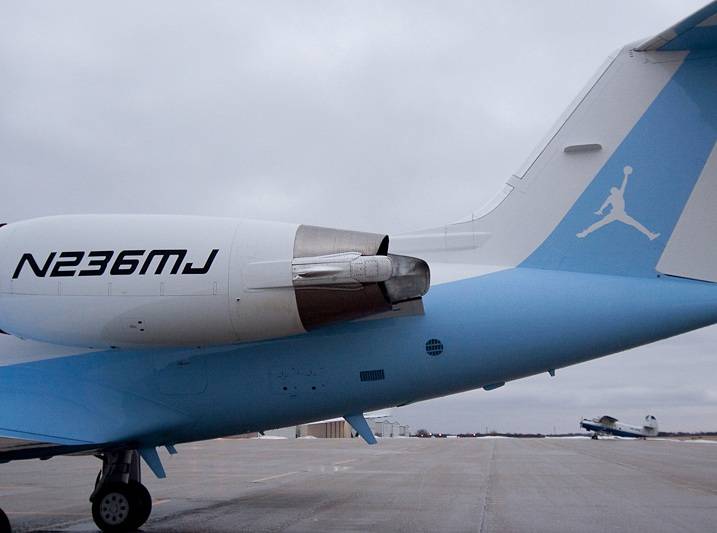
Michael Jordan: #23, 6 NBA Championship Rings.
Of course, you can always customize your N-number (within some pretty specific FAR limits) if you'd rather broadcast your identity to the world.  Actually, at $10, it's a better deal than the vanity plates in my home state.  Passengers out there, have you ever wondered why so you hear so many "November"s over the radio on cross-country trips?* ID numbers on every plane registered in the US must begin with "N" by law - every from Guernsey to South Africa has a similar international identifier.  There are plenty of vanities already registered (N1KE, N32MJ, and N236MJ, among others) so jump on it if you're too good for Harrison Ford.

Since 99% of us aren't too good for Harrison Ford, we'll continue to experience the thrill of learning new ways to call ourselves every time we hop behind a new yoke.  Language is strongly linked to memory, and self-recognition to autobiographical memory in particular.  To come full circle, these letters and numbers we use to steer clear of traffic in the sky become a deeply integrated part of how we perceive ourselves as pilots.  A passenger once told me that she had trouble picking out our call sign among all the ATC jargon in the sky, and I realized that what sounded to her like gibberish has begun to sound to me like poetry.

--

*A recent passenger, who shall remain anonymous, actually asked this on my last trip.


Thursday, May 29, 2014

Tradition

I was listening to an interview the other day with the man responsible for the lyrics in Fiddler On The Roof, which happens to be celebrating its 50 year anniversary.  He spoke about many interesting facets of the show, but I thought the most interesting few minutes were about the songs they didn't end up using, including the original opening number.
"It wasn't used because when Jerome Robbins became our director, we had many, many meetings before we went on to rehearsal. At each meeting he started with the same question: what is this show about? And he would say there's something that gives this show its power and we don't know what it is. And finally at one of those meetings one of us said hey, you know what this show is about? It's about changing of the way of life of a people in these Eastern European communities, these little towns, these shtetls, and Robbins got very excited about that. He said if that's the case, then what you have to write is a number about traditions, because we're going to see those traditions change. And that's so important in the show. Every scene or every other scene will be about whether a tradition changes or whether it remains the same. So instead of a song with the mother and the daughters getting ready for the Sabbath, he wanted us to write a song about tradition because he thought that's what the show is really about."

This weekend I had the chance to visit my fiancĂ©'s family cabin for Memorial Day weekend.  If you grew up somewhere other than the Northwoods (like I did), you may not understand the traditional significance of that holiday in that part of the world.  It's the unofficial start of summer, and it's easy to see just how widespread that celebration is when you're actually there.  Towns double in size, boat engines roar to life for the first time in months, and spirits are high.  These folks are creatures of habit in a strange but endearing way.

While I did grow up as a creature of the plains, I was extremely fortunate to have experienced aviation from an early age through the pilots God gave me for a father and grandfather.  I've heard it said that there are ultimately only old pilots and bold pilots, and becoming a third-generation old pilot is definitely a tradition I aim to honor.

My future grandmother in law sees us off
This weekend, our family traditions collided when I flew that rental Archer up to D25.  It's a marvelous little airport if you ever have the chance to visit.  I had the opportunity to take my future father in law and grandfather in law up for a little aerial tour of the area they've been frequenting for decades by car, and it was an experience I will absolutely never forget.

I think we as general aviators know Tevye's love for tradition as well as anyone.  Our planes are, on average, over 40 years old.  At our best, we rely on checklists and procedures to give our flights a firm foundation.  At our worst, we get stuck longing for the golden age of aviation to return without actually getting off our rears and doing what we can about it, and I think that's the side that concerns me.  If you haven't seen Fiddler, watched the above clip, or heard of the concept of foreshadowing, here's a little spoiler alert: in the end, Tevye's traditions can't save his village from the sweeping societal changes knocking at his door.  Its residents are eventually forced to adapt, but one can only imagine how much more difficult that integration was as a result of their longtime resistance.  On the one hand, they experienced a life very few others around the world were able to perceive.  On the other, that same world left them in the dust.

So what's it going to be?  Will we continue to lose 10,000 private pilots per year, dump lead into the atmosphere out of Metathesiophobia, or resist technological changes that will increase situational awareness for every pilot? Or will we honor our collective heritage by embracing the future with all its costs and benefits, and make of it what we can?

Let's choose the latter.  Let's honor our collective heritage of innovation and responsibility that has made aviation great. Let's fly.